
Walk Your Worries
When stress and worry can become overwhelming, it can help to have something that you can do with deliberation to deal with it. Call it a sense of agency, call it distraction- call it what you will. I call it a tool, and if there's one thing I love, it's tools to use when we feel like we alone cannot manage the feelings that we are experiencing.
Introducing… WALKING! The amazing psychological tool that you have had for so many years that you have probably taken it for granted. I wouldn't be surprised if you are rolling your eyes a little. I suppose we can all admit that walking is a physical activity that gets our blood pumping and oxygen flowing, which is good for brain function in general. But what could walking possibly do for the feelings we experience- certainly they aren't connected… or are they?
Come to find out, walking can do several things to help us with psychological discomfort. To begin, walking forces our brains to scan left to right to assess for safe travel. This lateral eye movement is the key to optic flow, which is the steady processing of the surrounding environment that constantly updates our position in space and our level of safety. As we move towards objects they become larger, we take in visual information that assesses the difference between benign objects and threats, and we navigate our body, adjusting course as needed.
This optic flow is the premise behind the world of EMDR (Eye Movement Desensitization and Reprocessing) therapy which has shown great promise for PTSD and anxiety as it quiets the amygdala (our primitive “fear center”). This deactivation turns off the “fight or flight” response that the amygdala alarm raises, which can make it easier to revisit troubling memories or think about uncomfortable situations. The alternating eye movement also helps the brain to coalesce the processing power of both sides of our brain, which means that we are able to make better decisions, feel more confident in those decisions, and find inspired creativity. This is as true for today's big thinkers as it was for the ancient Greek scholars. This integration of both hemispheres is magnified by the rhythmic movement of walking (which can also be achieved with jogging or running for those who are more motivated than me!).
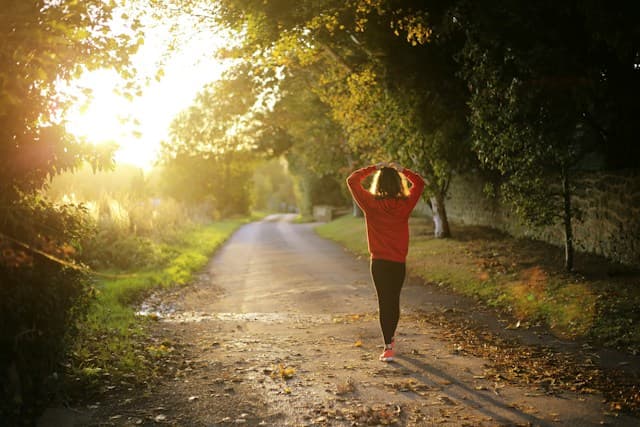
Walking can take place anywhere. Down the halls of your office or along the storefronts of a mall, any walking is good walking, but if you might want to amp up the impact of your walking, consider going outside to make moves. Walking outside adds several significant benefits to just getting your steps in. Being in the sunlight produces vitamin D in the deep layers of our skin which contributes to a sunny mood as well as helping to set the circadian rhythm that helps set our internal clocks and influence sleep cycles.
To take it up another notch, consider the Japanese practice of Shinrin Yoku, which translates to “forest bathing”. In Shinrin Yoku, practitioners walk slowly and consciously through the forest, utilizing all their senses to reduce blood pressure, enhance immunity, and disconnect from the hyper-paced digital world that we are steeped in. This means consciously seeing sunlight filtering through the layers of green leaves, smelling the pines and musky earth, listening to the sound of the wind gently moving the treelimbs and the echo of birdsong. It means feeling the cool air and running your fingers over moss covered logs. It is a practice of nature immersion, and it has found recognition not only in Japan but throughout the world as a beneficial complementary therapy, and some even suggest nature “prescriptions”. Combined with the bilateral stimulation of walking and visual scanning, I would be surprised if anyone who made a genuine attempt did not find the practice a salve for the soul!
Whether you are walking on a treadmill in your home office or on a less beaten path through an untouched forest, the spectrum of benefits are there for the taking. Free and readily accessible, walking for your psychological health is definitely worth a try. Consider walking with someone to have an uncomfortable conversation. Maybe step into your sneakers for a collaborative phone meeting or interview. Maybe just take a walk because it's a beautiful day. I bet you will feel better afterwards!
A few cool links :)
https://ihike.org/walking-thinking-and-optic-flow/
https://www.newyorker.com/tech/annals-of-technology/walking-helps-us-think